
L-LINE DIGITAL
← All products
MCP server · Free tier · MIT licensedv0.1 — available now

DeFi UX MCP

An MCP server that gives AI agents direct access to the L-LINE DIGITAL DeFi UX rubric, named patterns, and cognitive-bias glossary. Install once, use it from Claude Desktop, Cursor, Codex, or any MCP-compatible client.

What it is

An MCP (Model Context Protocol) server that exposes the L-LINE DIGITAL DeFi UX rubric, 10 named UX patterns, and a 5-entry cognitive-bias glossary as callable tools — search_defi_ux, get_rubric, get_pattern, get_glossary_entry, and list_categories.

How it works

Clone the repo, run npm install and npm run build, and add a four-line entry to your AI client's MCP config (Claude Desktop, Cursor, Codex, and other stdio-compatible clients). The free tier is the full 8-area rubric, 10 patterns, and 5 glossary entries, MIT-licensed, no API key; the $29/mo Pro tier adds 50+ named-protocol patterns, 30+ glossary entries, and a screenshot-based audit endpoint.

Why it's worth it

A tool call returns the exact rubric criteria, named pattern, or bias definition L-LINE DIGITAL actually uses — not a paraphrase reconstructed from training data or a document chunk retrieved by similarity search. That's why the model can score a screenshot against the same 8 weighted areas every time, instead of giving inconsistent, un-sourced advice the way generic chat or RAG-over-docs would.

Why an MCP server

Frameworks that are useful at the moment of decision.

Most UX frameworks live in PDFs and blog posts — you read them once, then forget them at the moment you actually need them. An MCP server flips that round. The L-LINE DIGITAL DeFi UX framework becomes something your AI assistant calls directly, every time you ask it to review a screen, a flow, or a transaction. The rubric is one tool call away. The named patterns are searchable. The cognitive biases are looked up by the model and applied to your specific context, not yours to remember.

See it in action

One prompt. A scored audit and a fix.

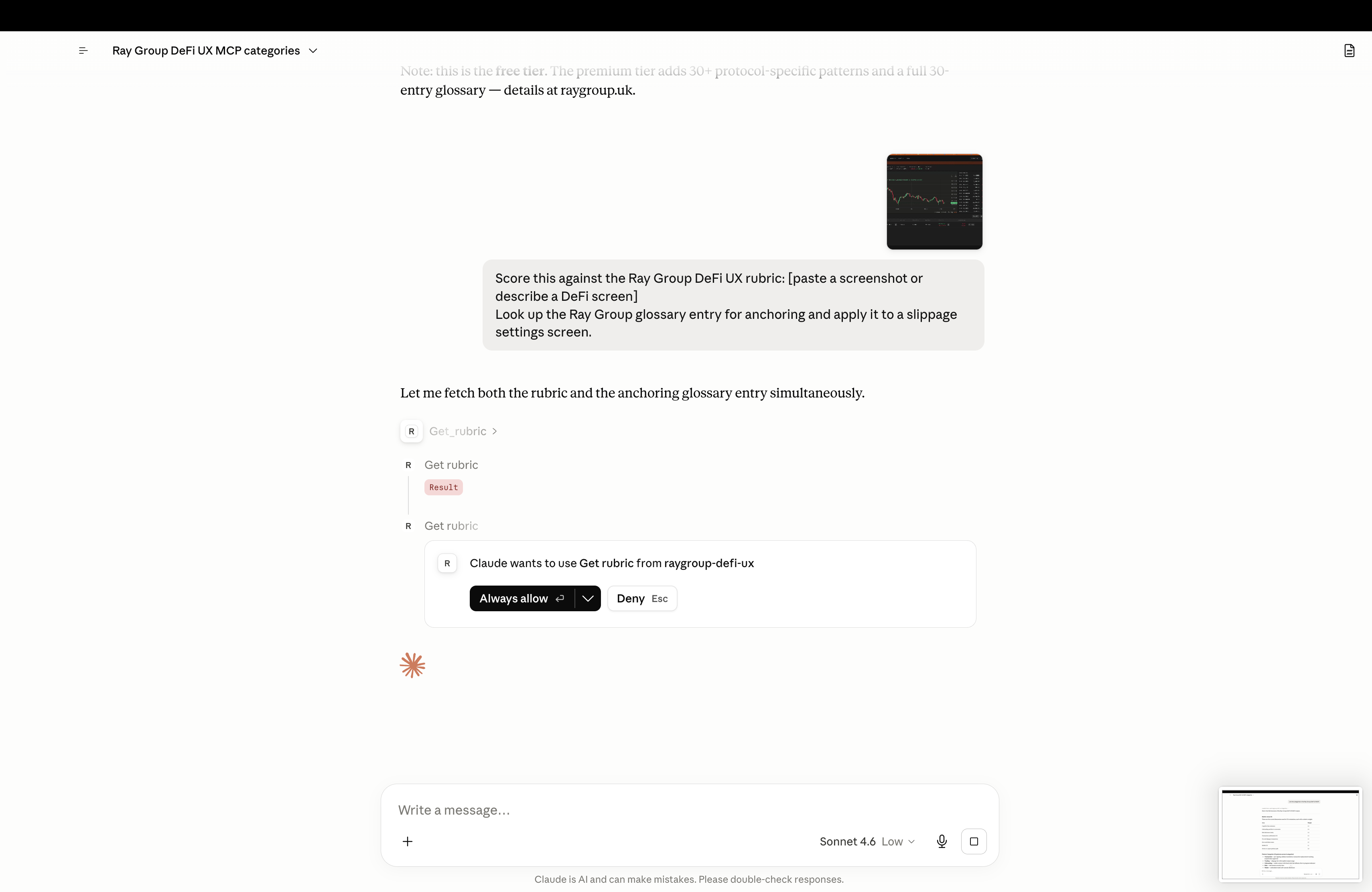
Here's a real run inside an MCP-connected AI client. The user pastes a screenshot of a BTC/USD perps DEX and asks for an audit. The model calls the L-LINE DIGITAL tools directly, scores the interface against the rubric, then applies the anchoring glossary entry to propose a concrete redesign.

Claude · raygroup-defi-ux · List the categories1 / 4
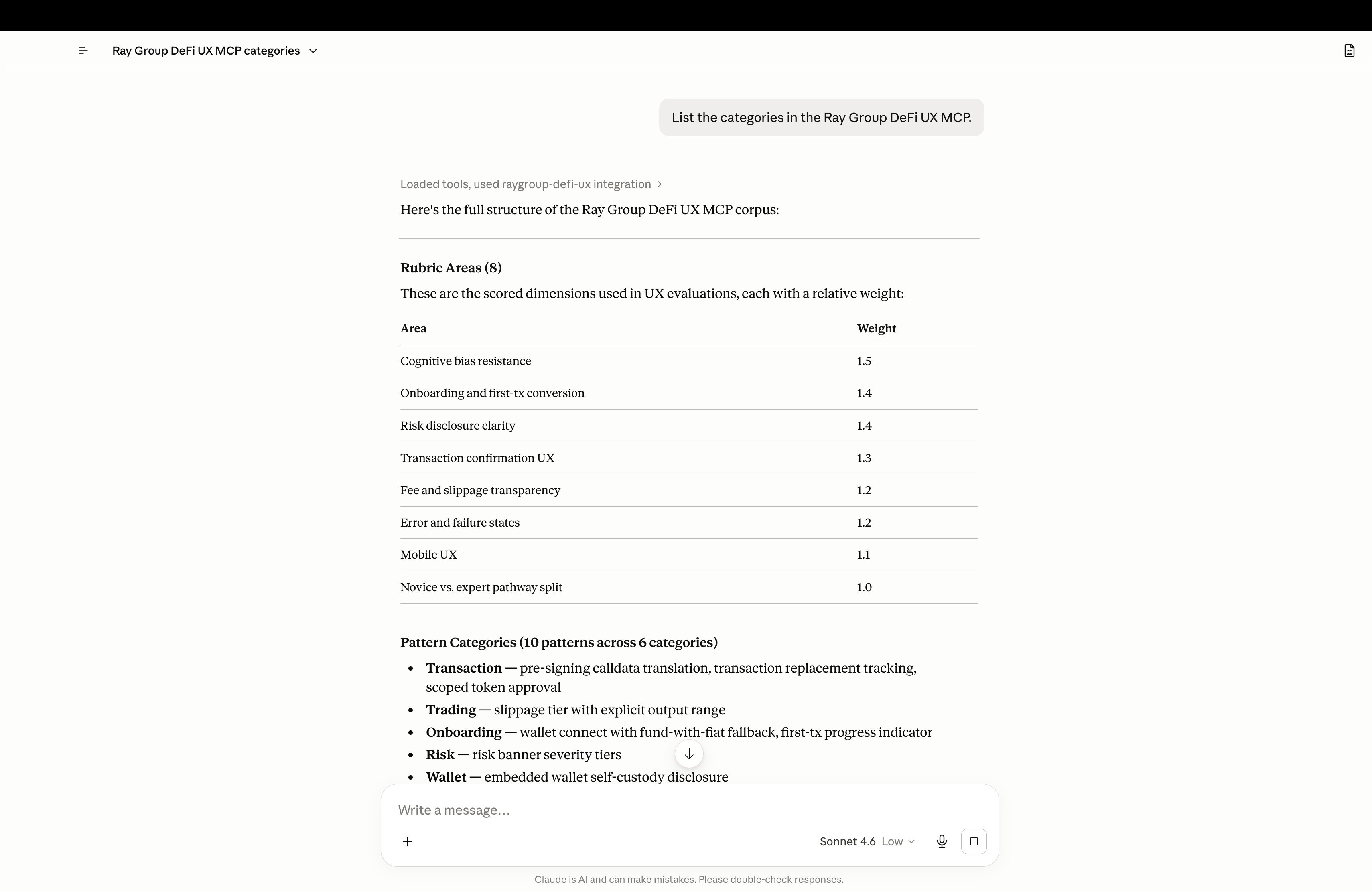
Claude calling list_categories on raygroup-defi-ux: a table of 8 rubric areas with weights, and pattern categories grouped by type.

Step 1. list_categories returns the full corpus structure — 8 weighted rubric areas, 10 named patterns grouped by category, and the glossary index.

Example audit · transcript

A BTC/USD perps DEX, scored.

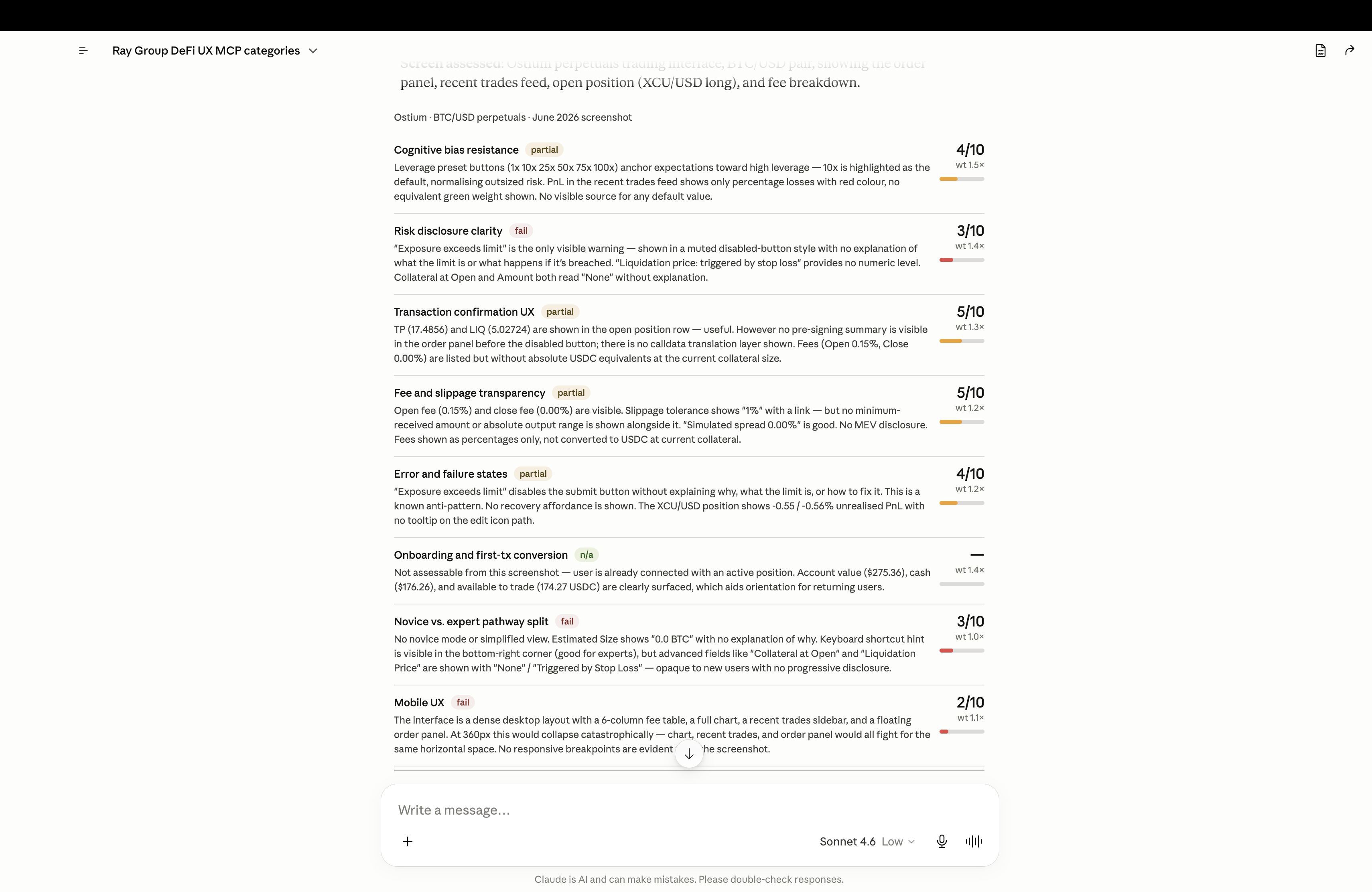
The same scored output you saw in the carousel — rendered here as text so it's readable, searchable, and accessible to assistive tech and answer engines.

3.7/10

Weighted · 7 scored areas

  • Cognitive bias resistance

    partial4/10wt 1.5×

    Leverage preset buttons (1× · 10× · 25× · 50× · 75× · 100×) anchor expectations toward high leverage — 10× is the highlighted default, normalising outsized risk. The trades feed shows only percentage losses in red, with no equivalent green weight and no source for the default.

  • Risk disclosure clarity

    fail3/10wt 1.4×

    “Exposure exceeds limit” is the only visible warning — shown in a muted, disabled-button style with no explanation of what the limit is or what happens if it's breached. Collateral fields read “None” without explanation.

  • Transaction confirmation UX

    partial5/10wt 1.3×

    Take-profit and liquidation levels are shown in the open-position row — useful. But there is no pre-signing summary and no calldata-translation layer before the wallet prompt.

  • Fee and slippage transparency

    partial5/10wt 1.2×

    Open and close fees are visible. Slippage tolerance shows “1%” with a link — but no minimum-received amount or absolute output range alongside it, and no MEV disclosure. Fees shown as percentages only.

  • Error and failure states

    partial4/10wt 1.2×

    “Exposure exceeds limit” disables the submit button without explaining why, what the limit is, or how to fix it — a known anti-pattern. No recovery affordance is shown.

  • Onboarding and first-tx conversion

    n/awt 1.4×

    Not assessable from this screenshot — the user is already connected with an active position.

  • Novice vs. expert pathway split

    fail3/10wt 1.0×

    No novice or simplified view. A keyboard-shortcut hint is good for experts, but advanced fields are shown with placeholder values and no progressive disclosure for new users.

  • Mobile UX

    fail2/10wt 1.1×

    A dense desktop layout — a multi-column fee table, full chart, trades sidebar, and floating order panel. At 360px this would collapse catastrophically; no responsive breakpoints are evident.

Anchoring, applied

Why the “1% slippage” field fails the user.

  • 1. The 1% default is an unexplained anchor. The user reads it as the protocol's recommendation of what's normal, with no reference for whether 1% is aggressive or conservative for this pair. The glossary's design lever: show the source of the default.
  • 2. No output range is shown alongside it. The rubric asks for an expected vs. minimum-received amount, not a bare percentage. 1% sounds small; in absolute terms on a leveraged position it isn't.
  • 3. The alternatives are hidden behind a link. Surface the alternatives at decision time, not behind a settings menu the user never opens.

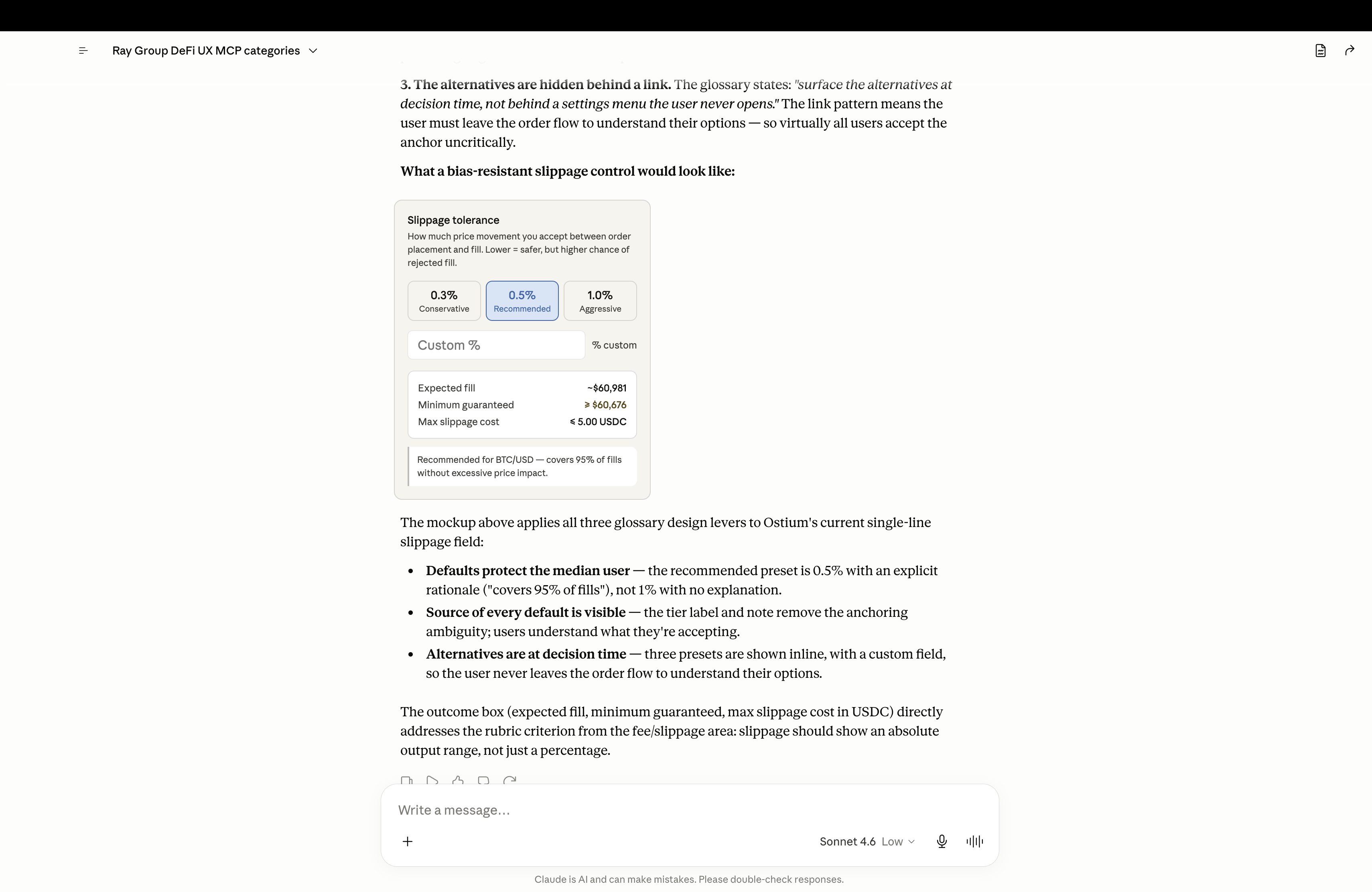
The bias-resistant control it proposes

Slippage tolerance

How much price movement you accept between order placement and fill. Lower = safer, but higher chance of a rejected fill.

0.3%

Conservative

0.5%

Recommended

1.0%

Aggressive

Expected fill~$60,981
Minimum guaranteed≥ $60,676
Max slippage cost≤ 5.00 USDC

Recommended for BTC/USD — covers 95% of fills without excessive price impact.

Illustrative run. Scores and findings are generated by the AI client from the rubric the MCP server returns — not pre-written.

What the server exposes

Five tools, ready to call.

search_defi_ux

Free-text search across the entire corpus — rubric areas, named patterns, and the glossary — ranked by relevance.

get_rubric

Returns the eight-area DeFi UX rubric with criteria and evidence prompts. Optionally filter to a single area.

get_pattern

Returns named DeFi UX patterns. Filter by slug, by category (onboarding, transaction, risk, wallet, trading, error, novice-expert), or by rubric area.

get_glossary_entry

Returns a cognitive-bias / heuristic / principle entry with its DeFi-specific manifestation and the design levers that mitigate it.

list_categories

Returns the full top-level structure of the corpus — every rubric area, every pattern slug, every glossary entry slug.

The corpus

An opinionated v1, free forever.

The free tier ships with the full rubric and a deliberate first cut of patterns and glossary entries. The premium tier extends each section significantly, but the free tier is genuinely useful from day one — and it stays free.

8 rubric areas

Cognitive bias resistance, risk disclosure, transaction confirmation, fee and slippage transparency, error and failure states, onboarding and first-tx, novice vs. expert split, and mobile UX. Each with criteria, evidence prompts, and common anti-patterns.

10 named patterns

Pre-signing calldata translation, slippage tier with output range, wallet connect with fund-with-fiat fallback, transaction replacement tracking, risk banner severity tiers, embedded-wallet self-custody disclosure, scoped token approval, first-tx progress indicator, network mismatch recovery, and expert keyboard shortcuts.

5 cognitive-bias entries

Anchoring, loss aversion, action bias, framing effect, and choice overload — each with the bias's general definition, its specific manifestation in DeFi, and the design levers that mitigate it.

Install

Two to three minutes, any MCP-compatible client.

Clone, build, and add four lines to your AI client's config. That's it. The server runs locally over stdio — no account, no API key, no network round-trip per call.

Enter your email to get the install steps

We'd like to know who's trying DeFi UX MCP. Your email unlocks the instructions below — we won't add you to a newsletter.

We'll only use this to follow up about DeFi UX MCP if something breaks. No spam, no sharing your address.

Frequently asked

About the MCP.

What is an MCP server, and why would I install this?
MCP (Model Context Protocol) is the open standard that lets AI clients like Claude Desktop, Cursor, and Codex call external tools. Installing this server gives every prompt in those clients direct, structured access to the L-LINE DIGITAL DeFi UX framework — so when you ask 'review this trading screen', the model can look up the actual rubric, the relevant named patterns, and the underlying cognitive biases, instead of generating advice from training data.
What's in the free tier vs. the premium tier?
Free tier: the full 8-area rubric, 10 named patterns, and 5 glossary entries — installable today, MIT-licensed, no API key. Premium tier (in development): 50+ named patterns with named-protocol references, 30+ glossary entries, a screenshot-based audit endpoint, anonymised case studies, and an API-key-authenticated hosted version for cloud-hosted agents.
How long does it take to install?
Two to three minutes. Clone the repo, run npm install and npm run build, and add a four-line entry to your AI client's MCP config. Detailed instructions per client are in the README.
Where does the framework come from?
The rubric is the same one L-LINE DIGITAL uses on every DeFi UX audit and the framework taught in our talks at EthCC, ETH Prague, and ETH Milan. The named patterns reflect recurring UX decisions we see across DeFi products. The cognitive-bias entries come from foundational behavioural-economics research adapted to the specific patterns we see on-chain.
Is it open source?
Yes — the free-tier MCP server is MIT-licensed. The full repo will be public on GitHub. The corpus content is also part of the repo, so any improvements the community contributes flow back into the public version.
Will this work with [my AI client]?
It works with any client that supports the Model Context Protocol over stdio — at the time of writing, that's Claude Desktop, Cursor, Codex CLI, Cline, Continue, and a growing list of others. Configuration is the same shape across clients (a small JSON block pointing at the binary).
When does the premium tier ship?
Targeting Q3 for premium-tier early access. Joining the waitlist gets you the first invites and a discount at launch.

Pro tier

Free to install. Pro when you ship with it.

Everything in Free, plus the extended corpus, hosted transport, and priority support for teams shipping DeFi UX.

Free

$0forever

8 rubric areas · 10 named patterns · 5 cognitive-bias entries

Install in 2 minutes

Pro

$29/ seat / month

50+ named patterns · 30+ glossary entries

See pricing

Per seat · billed via Stripe